Einstein's Cross
Quasar QSO2237+0305
Galaxy PGC69457
Date: July 30, August 8, 11 & 13, 2005
Camera: SBIG STL6303E (7/30/05) SBIG ST10XE (8/8,11&13/05)
Filters: AstroDon Luminance
Camera control software: CCDSoft
Focal reducer: None
Telescope: RCOS 16 Carbon Tube, Aries optics, F9
Telescope control software: RCOS TCC, TheSky6
Mount: Paramount ME (MKS 4000)
Guiding/adaptive optics: internal self-guided, no AO7 on STL6303E/A07 on ST10XE
Camera temperature: -10C
Conditions: Variable seeing and poor transparency, intermittent clouds.
Processing: MaximDL, CCDSharp, Registar, Photoshop CS2.
Quasar QSO2237+0305
Galaxy PGC69457
Date: July 30, August 8, 11 & 13, 2005
Camera: SBIG STL6303E (7/30/05) SBIG ST10XE (8/8,11&13/05)
Filters: AstroDon Luminance
Camera control software: CCDSoft
Focal reducer: None
Telescope: RCOS 16 Carbon Tube, Aries optics, F9
Telescope control software: RCOS TCC, TheSky6
Mount: Paramount ME (MKS 4000)
Guiding/adaptive optics: internal self-guided, no AO7 on STL6303E/A07 on ST10XE
Camera temperature: -10C
Conditions: Variable seeing and poor transparency, intermittent clouds.
Processing: MaximDL, CCDSharp, Registar, Photoshop CS2.
Einstein's Cross
Quasar
QSO2237+0305;
PGC69457
Quasar
QSO2237+0305;
PGC69457
Quasar QSO2237+0305, the
so-called "Einstein's Cross". The
Quasar is perhaps 8 to 13 Billion light
years away. In addition, there is a
faint galaxy (PGC 69457) about 500
Million light years away that happens
to be straight in line with the Quasar.
Einstein's General Relativity theory
predicted that light would be lensed
by gravity, and this has been
confirmed by a large number of
observations, including by
observations of this Quasar. In
images taken by telescopes under
good seeing conditions, the Quasar's
light, bent by the intervening galaxy,
appears as a multiple image of 4 lobes
(a cross).
To the left are three close up images
of the core showing the beginning of
some structure. In the rightmost
and bottom images taken on a night
of better seeing, there is some
evidence of the components of the
Quasar.
so-called "Einstein's Cross". The
Quasar is perhaps 8 to 13 Billion light
years away. In addition, there is a
faint galaxy (PGC 69457) about 500
Million light years away that happens
to be straight in line with the Quasar.
Einstein's General Relativity theory
predicted that light would be lensed
by gravity, and this has been
confirmed by a large number of
observations, including by
observations of this Quasar. In
images taken by telescopes under
good seeing conditions, the Quasar's
light, bent by the intervening galaxy,
appears as a multiple image of 4 lobes
(a cross).
To the left are three close up images
of the core showing the beginning of
some structure. In the rightmost
and bottom images taken on a night
of better seeing, there is some
evidence of the components of the
Quasar.

Five 8 minute luminance
subexposures, average
FWHM approx. 2.1 arcsec.
July 30, 2005
subexposures, average
FWHM approx. 2.1 arcsec.
July 30, 2005
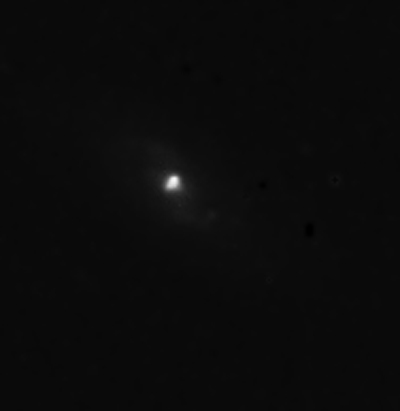
Above: approximately twenty 5 minute
luminance subexposures, average
FWHM 1.5 to 1.7 arcsec. August 8,
2005.
luminance subexposures, average
FWHM 1.5 to 1.7 arcsec. August 8,
2005.
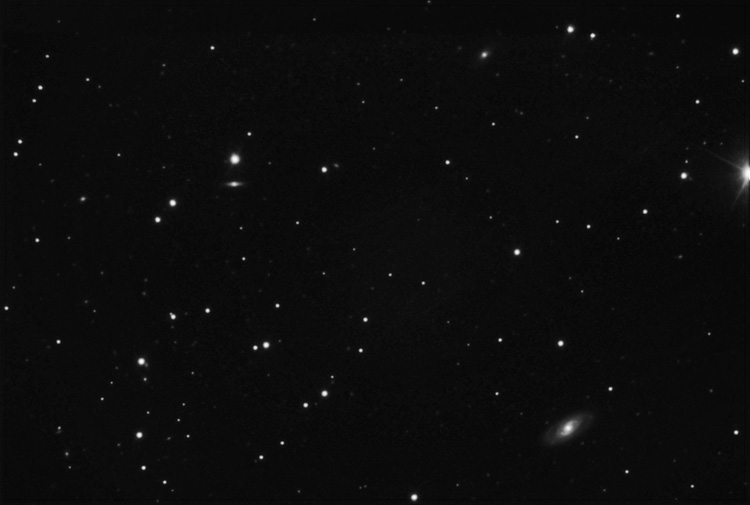
Full field view with ST10XE (9.4 x 14 arc minutes). August 11, 13,
2005. PGC 69457/Quasar QSO2237+0305 at lower right.
2005. PGC 69457/Quasar QSO2237+0305 at lower right.
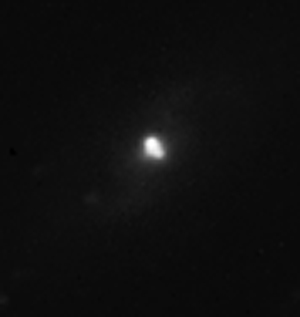
Left: best five of the above 5
minute luminance
subexposures, average
FWHM approx. 1.5 arcsec.
August 8, 2005
minute luminance
subexposures, average
FWHM approx. 1.5 arcsec.
August 8, 2005